
The Glyphosate Debate Is Missing the Point
While lawyers argue over who gets to regulate it, nobody's asking why it's still on the shelves, or helping farmers find something better.

I’ve spent two decades watching the debate around our food system get hijacked by the loudest argument in the room. Right now, that argument is preemption, the legal question of whether federal law overrides state and local attempts to warn consumers about glyphosate, the active ingredient in Roundup.
Courts are wrestling with it. There are active lawsuits representing sick farmers nationwide. Advocates are organizing around it. And I understand why. It is a fight worth having.
But I want to ask a simple question:
Why are we arguing about the label and not the product itself?
Preemption is a procedural question. It’s about jurisdiction, who gets to put a label on a bottle. And while that fight consumes our energy and attention, the herbicide itself remains on the market, sprayed on hundreds of millions of acres of American farmland, residues showing up in our cereals, in our honey, even in umbilical cord blood.
The substance isn’t on trial. The warning label is.
That’s a distraction. And we can’t afford it.
Let’s be honest about what we know.
The International Agency for Research on Cancer classified glyphosate as a probable human carcinogen in 2015. That’s not a fringe finding, IARC is the cancer research arm of the World Health Organization, and it doesn’t use the word “probable” lightly. Since then, litigation has unearthed thousands of internal documents from Bayer (which acquired Monsanto) showing company scientists and executives who were, at minimum, deeply uncomfortable with some of the findings about their flagship product.
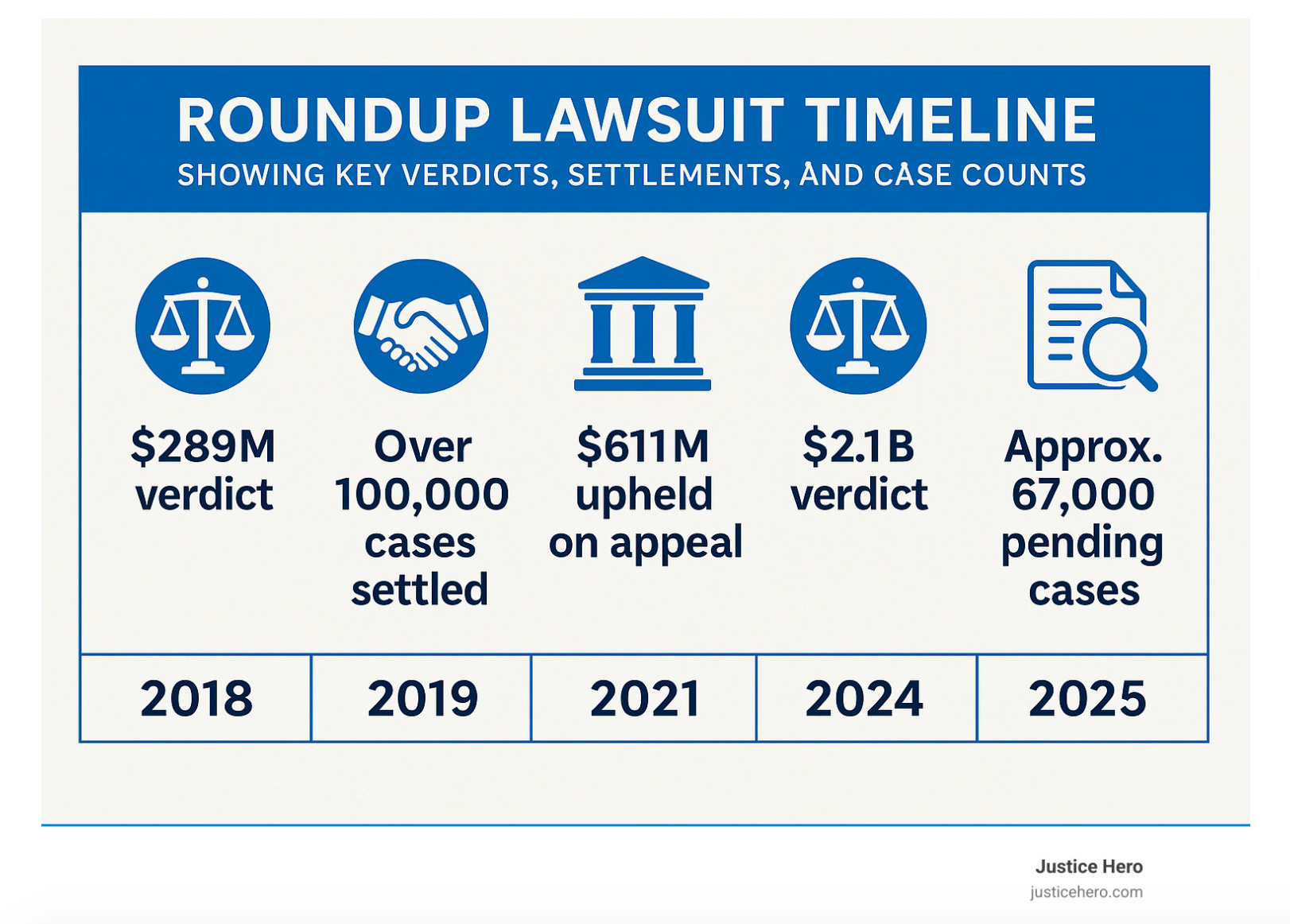
Juries have agreed. Billions of dollars in verdicts have been rendered. Attorneys continue to line up. And still, glyphosate is being sold, applied, and consumed.
So let’s ask the question plainly: why hasn’t it been pulled from the market?
That’s not rhetorical. It’s the question our regulatory agencies should be answering in public, with data they’re willing to defend. The EPA’s position, that glyphosate is “not likely to be carcinogenic to humans,” puts it at direct odds with IARC and with growing independent science. When federal regulators and international health bodies can’t agree on something this fundamental, that should trigger scrutiny, not a preemption lawsuit.
Now we know it goes further than that. Internal EPA emails obtained through a FOIA request and revealed at a congressional hearing last week show that Bayer met with EPA Administrator Lee Zeldin and his senior staff to discuss its Supreme Court litigation strategy and promised him “a small thanks” for updating the agency’s glyphosate webpage in a way that withdrew support for California’s cancer warning. That update was subsequently cited in the Solicitor General’s brief backing Bayer’s case before the Supreme Court.
This is not a system failing by accident. This is a system working exactly as its most powerful participants intended.
Waiting for that system to fix itself is not a strategy. It’s a prayer.
The people paying the price aren’t the ones in the courtroom.
When I talk about glyphosate, I always come back to farmers. American farmers in particular. Because we have done them a profound disservice.
American farmers didn’t wake up one day and decide to drench their fields in herbicide. They were sold a system, a fully integrated package of genetically engineered seeds and the chemicals those seeds were designed to tolerate. They were told it was the future of agriculture. They were promised efficiency, yield, and simplicity. And many of them bought in, literally, often going into debt to do so.
Now, decades later, we have superweeds resistant to glyphosate spreading across millions of acres. We have soil microbiome disruption that scientists are only beginning to understand. We have farmers increasingly trapped in a chemical treadmill, applying more product to get the same results they used to achieve with less, and carrying record levels of debt to achieve it.
And what are we offering them? A label fight.
Farmers deserve better than that.
They deserve investment in alternatives. They deserve research into regenerative practices that can genuinely compete on yield and economics. They deserve a transition pathway that doesn’t bankrupt them. And they deserve an honest conversation from the rest of us, from consumers, from advocates, from policymakers, that says: we know this system isn’t working, and we are going to help you find a way out of it.
What we should be doing instead.
First, let’s redirect some of the advocacy energy that’s going into preemption litigation toward demanding a comprehensive, independent re-review of glyphosate’s safety profile, one that isn’t funded or influenced by the registrant, and one that accounts for the most recent science on endocrine disruption, gut microbiome effects, and combined exposures.
Second, let’s put real money behind alternatives. I cannot emphasize this enough.
The federal agriculture research budget is a fraction of what it should be, and too much of what exists flows toward conventional commodity agriculture.
We need robust public investment in cover cropping, precision weeding technology, biological pest management, and the agronomic knowledge that makes these systems actually work at scale. Some of the most exciting tools in this space, laser weeding robots, targeted biological herbicides, AI-assisted precision application, are advancing rapidly. They need funding and farmer-facing infrastructure to become real options, not just conference presentations.
Third, let’s change the economics. Right now, the cheapest option available to many farmers is still the chemical one, because the externalized costs, health impacts, water contamination, biodiversity loss, are borne by everyone else, including their families.
We need agricultural policy that doesn’t just talk about the label, but that rewrites those incentives.
Make the transition to safer systems economically viable, and farmers, who are, at their core, businesspeople trying to survive on brutal margins, will make different choices.
Fourth, let’s support farmer-to-farmer networks. The most compelling evidence that alternatives work comes from farmers who are already doing it. Peer learning is more persuasive than any government pamphlet. Invest in the networks, the field days, the mentorships that spread real-world knowledge of what’s possible.
A final word on the preemption debate.
I’m not saying it doesn’t matter. It does. If states and localities can’t warn their residents about potential risks, that’s a genuine problem for democracy and for public health.
But don’t let it substitute for the harder conversation.
Warning labels don’t protect farmers whose livelihoods depend on a system built around a product that may be harming them and their land.
Labels don’t clean up waterways. Labels don’t restore soil biology.
The question isn’t just who gets to put a warning on the bottle. The question is why the bottle is still being filled.
And more importantly: what are we prepared to do, together, to help the people who grow our food find a better way forward?
That’s the conversation I want to be having. I hope you’ll join me.
Robyn O'Brien is named to Forbes' Impact 50 List for her work at the intersection of food, agriculture, and climate. She is named after a farmer who is a cancer survivor, and she is the author of The Unhealthy Truth and Seeding Innovation.
I agree! There are so many blurbs in this piece that I want to highlight.
My understanding of why we are having the preemption fight right now (and I could be wrong) is because that's the strategy Bayer is currently using to try and get themselves immunity. So while we absolutely need to be doing more in the longterm to support farmers and transition to safer alternatives, we also need to put the most urgent fire out at this moment...?